
What goes into your brand identity
April 21, 2026
So this blog is a bit of a shameless plug to my latest resource, a free interactive workbook designed so you can understand your own brand identity which can be downloaded here.
This workbook basically outlines the areas mentioned below, but in more detail and gives you the ability to jot down your own thoughts. Sound great?…then skip this blog and download it, as all is explained in there.
If you’re just browsing the idea right now, then read on.
What you stand for
The below areas are basically your core parts to your brand identity. They are the foundations that your business is built on and the engine that drives your business.
Purpose
The purpose of your business is basically why it exists. It explains the businessʼs motivations and why it works, without the answer being ‘moneyʼ.
A purpose statement itself, is all of the above but broken down into a smaller statement. It needs to keep all those juicy bits and remain easy to digest for sharing with others.
An example of a purpose statement would be Legoʼs which is simply:
“Inspire and develop the builders of tomorrowˮ
Or mine, which is:
“Inspired by a love of design and a desire to craft unique visual identities to empower growth in businesses of all sizes.”
Mission
The mission of a business is simply what it does, who it serves, itʼs objectives and how it handles those objectives.
Hereʼs Appleʼs mission statement as an example:
“To bring the best user experience to its customers through its innovative hardware, software, and services.ˮ
…and mine is:
“Collaborating with passionate businesses on their path to recognition, through bold, creative storytelling.”
Vision
This one in my opinion is a bit more fun. Where do you want your business to be in the future. Who do you want to be working for?
As an example, BrewDogʼs vision statement is:
“To make others as passionate about great craft beer as they are, while revolutionising the industry by building a community-owned, sustainable, and transparent business.ˮ
…while mine is:
“To create bold brands that inspire big smiles, spark huge conversations, and give businesses a voice their customers love
and remember.”
Values
With values we step a bit away from what you do, and more about what you stand for, what your principles are and what guides your decisions, behaviour and boundaries.
The values of your businessʼs brand are like a compass. They point you towards what matters.
Vanʼs for example are:
“We are determined. We are connected to our consumers and to each other. We are inclusive. We are expressive and Fun. And most of all, we are a family.ˮ
Mine however, are:
Boldness → Dare to be different, push the creative boundaries.
Authenticity → Be genuine, be true, be you.
Collaboration → Work together to bring ideas to life.
Positivity → Maintain good vibes throughout the creative journey.
Balance → Hold firm boundaries, focus, move work forward with care
Beliefs
Now onto the beliefs and in some ways theyʼre actually quite similar to the values and some companies donʼt tend to worry too much about having them as well as values.
Where values are like a compass, pointing towards what matters, beliefs explain how you see the journey, like a map.
They essentially explain the reasoning behind the values and can go into more detail.
My beliefs go a little like this:
• I believe bold ideas will cut through boring, repetitive noise.
• I believe authenticity and being human is more valuable than ever, as
we enter a heavy AI world.
• I believe the best results come from asking the right questions, truly
understanding each other and working together.
• I believe work should be enjoyable instead of exhausting.
• I believe boundaries will help both myself and the client.
How you show up
So we’ve covered what you stand for, it’s now time to go over how you show up.
Attributes
The attributes are basically words and maybe descriptions of how the outside world perceives you. So basically, if
someone met this brand once, what would they say it feels like?
Examples for my own brand attributes would be:
Playfully Professional
Fun and approachable, but always polished and reliable.
Fresh Perspective
Feels modern, inventive, not same-old-same-old.
Creative Confidence
Bold, inventive, and not afraid to push boundaries.
Clear & Guided
Structured process, straightforward tiers, and no fluff.
Personality
Looking at a more psychological side of things now, we step towards the 5 dimensions of brand personality, which are based on the work by American social psychologist, Jennifer Aaker.
The diagram below is a recognised structure that helps bucket your brand into a category, pulling together similar patterned traits that consumers associate with a brandʼs character.
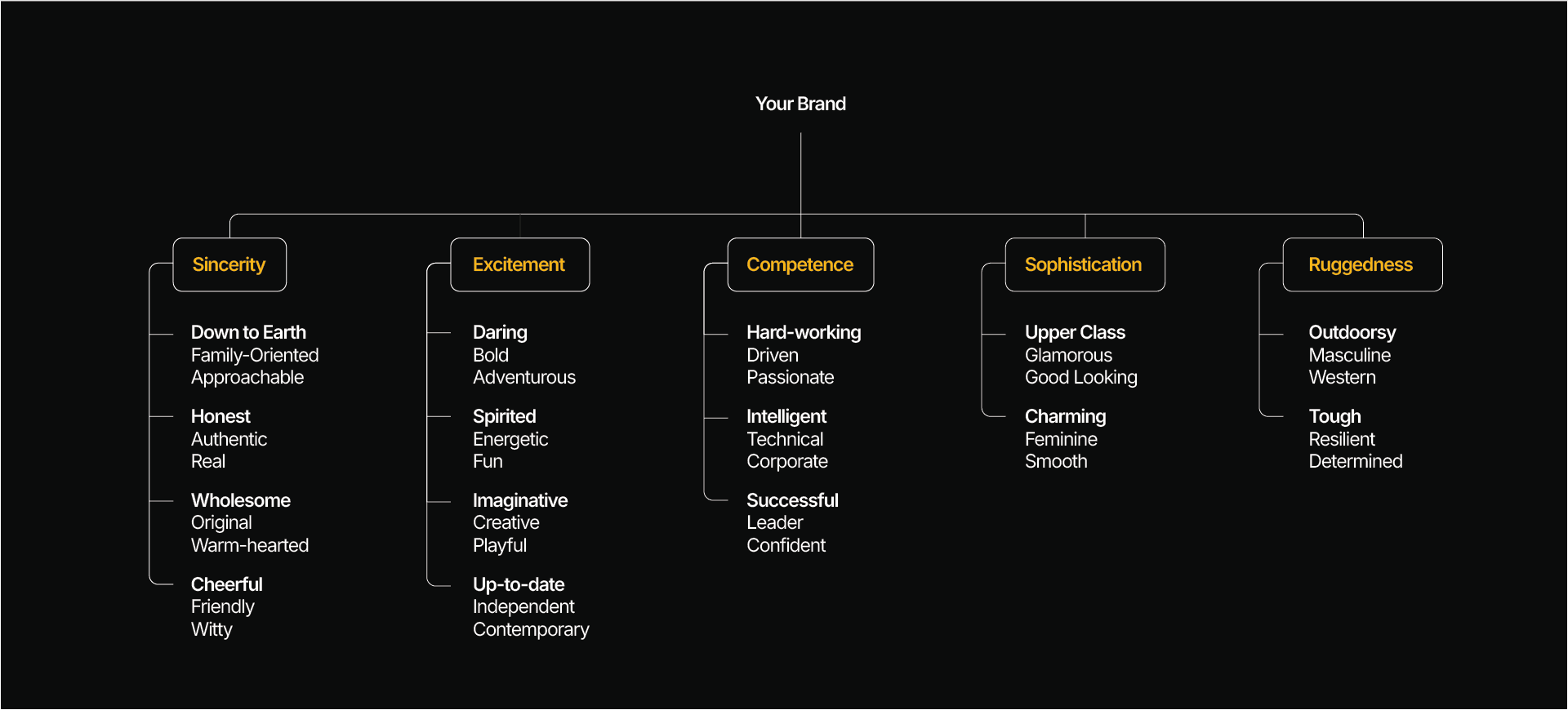
As an example Red Bull is under ‘Excitementʼ while Harley Davidson is under ‘Ruggednessʼ.
Iʼm awkward and have actually put myself under ‘Sincerityʼ while putting my work
under ‘Excitementʼ.
Traits
Similar to the 5 dimensions of brand personality, this section hones a bit more into your brandʼs own specific traits. Easy to remember words, tailored to your most dominant personality traits that
you want to push forward and emphasise in your marketing and other customer facing
experiences.
Remember, leaning more and more into your brandʼs personality traits help make you stand out and become memorable and unique. It might put some people off but if done correctly, your main target audience will love it.
My personality traits I want to lean towards the most are Light-hearted, Approachable, Honest, Creative and Passionate
Archetype
Lastly, moving deeper into the personality side of things and we look at the archetype, shown in the diagram below. Similar to previous sections, the brand archetype however is a universally recognised, psychology-based character persona based on the work by Swiss psychiatrist, Carl Jung.
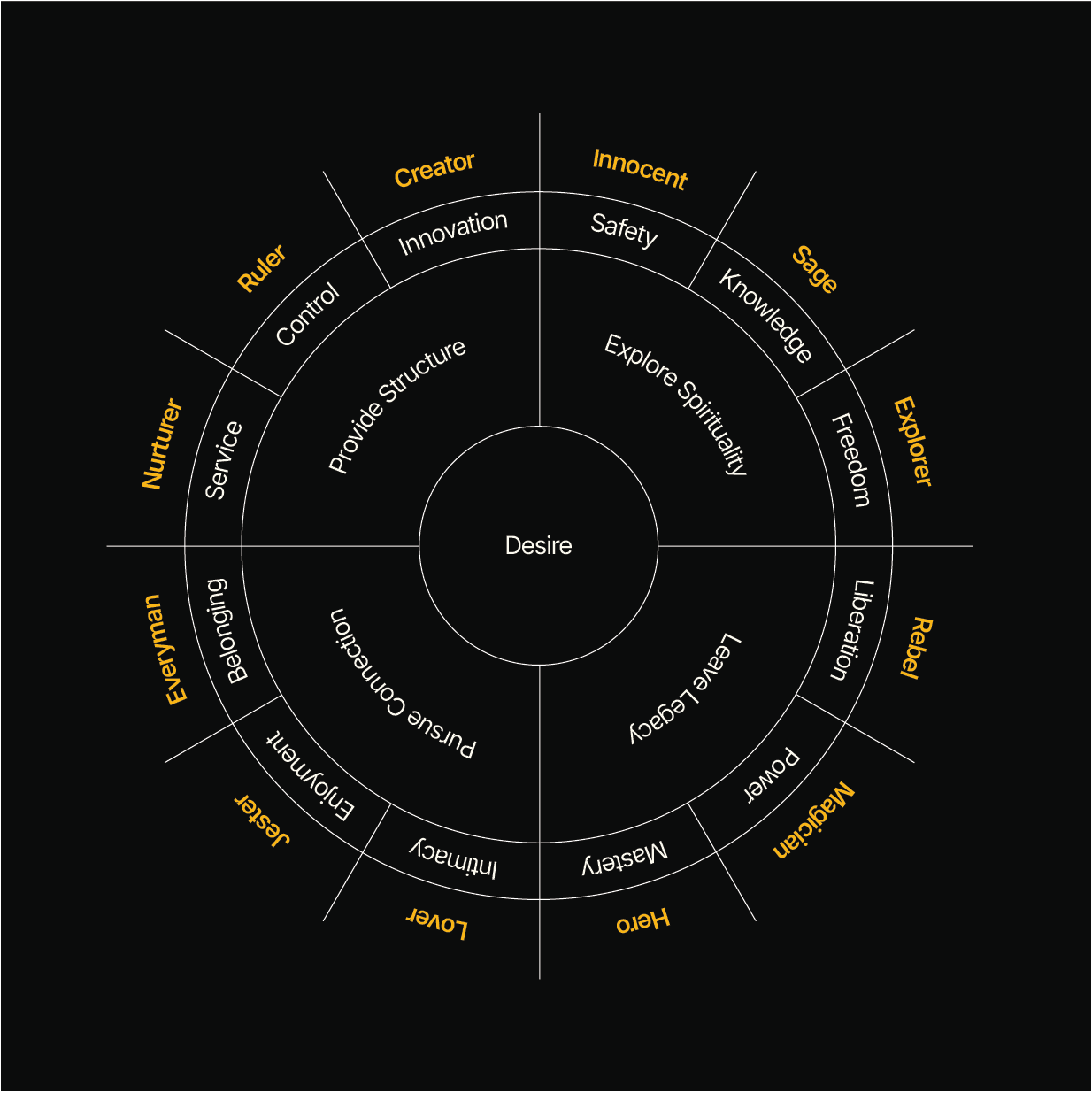
Itʼs used to define a brandʼs personality, values and behaviour and makes purchasable products have their own relatable entities, connecting with customers on an emotional level that builds trust and loyalty.
A few examples of big brands and their archetypes would be:
Apple = Creator, Nike = Hero, IKEA = Everyman, Unicef = Caregiver
I myself like to think that I sit under the ‘Creatorʼ archetype.
Summary
So that concludes most of the stuff that you’ll find in your brand identity.
Like I say, if you want to work on your own brand identity or even personal identity, you can download the interactive workbook here, where you’ll also be able to go over your tone of voice, common words / phrases and a tagline.
If you feel like you’ve got a lot of this sorted and are now looking for graphics that capture this identity, then make sure you get in touch.
Cheers.

Adam Hayles
Freelance Graphic Designer
15+ years in the graphic design world with a desire to provide brands with a fresh upbeat visual personality using design, illustration and animation.
What goes into your brand identity
April 21, 2026
So this blog is a bit of a shameless plug to my latest resource, a free interactive workbook designed so you can understand your own brand identity which can be downloaded here.
This workbook basically outlines the areas mentioned below, but in more detail and gives you the ability to jot down your own thoughts. Sound great?…then skip this blog and download it, as all is explained in there.
If you’re just browsing the idea right now, then read on.
What you stand for
The below areas are basically your core parts to your brand identity. They are the foundations that your business is built on and the engine that drives your business.
Purpose
The purpose of your business is basically why it exists. It explains the businessʼs motivations and why it works, without the answer being ‘moneyʼ.
A purpose statement itself, is all of the above but broken down into a smaller statement. It needs to keep all those juicy bits and remain easy to digest for sharing with others.
An example of a purpose statement would be Legoʼs which is simply:
“Inspire and develop the builders of tomorrowˮ
Or mine, which is:
“Inspired by a love of design and a desire to craft unique visual identities to empower growth in businesses of all sizes.”
Mission
The mission of a business is simply what it does, who it serves, itʼs objectives and how it handles those objectives.
Hereʼs Appleʼs mission statement as an example:
“To bring the best user experience to its customers through its innovative hardware, software, and services.ˮ
…and mine is:
“Collaborating with passionate businesses on their path to recognition, through bold, creative storytelling.”
Vision
This one in my opinion is a bit more fun. Where do you want your business to be in the future. Who do you want to be working for?
As an example, BrewDogʼs vision statement is:
“To make others as passionate about great craft beer as they are, while revolutionising the industry by building a community-owned, sustainable, and transparent business.ˮ
…while mine is:
“To create bold brands that inspire big smiles, spark huge conversations, and give businesses a voice their customers love
and remember.”
Values
With values we step a bit away from what you do, and more about what you stand for, what your principles are and what guides your decisions, behaviour and boundaries.
The values of your businessʼs brand are like a compass. They point you towards what matters.
Vanʼs for example are:
“We are determined. We are connected to our consumers and to each other. We are inclusive. We are expressive and Fun. And most of all, we are a family.ˮ
Mine however, are:
Boldness → Dare to be different, push the creative boundaries.
Authenticity → Be genuine, be true, be you.
Collaboration → Work together to bring ideas to life.
Positivity → Maintain good vibes throughout the creative journey.
Balance → Hold firm boundaries, focus, move work forward with care
Beliefs
Now onto the beliefs and in some ways theyʼre actually quite similar to the values and some companies donʼt tend to worry too much about having them as well as values.
Where values are like a compass, pointing towards what matters, beliefs explain how you see the journey, like a map.
They essentially explain the reasoning behind the values and can go into more detail.
My beliefs go a little like this:
• I believe bold ideas will cut through boring, repetitive noise.
• I believe authenticity and being human is more valuable than ever, as
we enter a heavy AI world.
• I believe the best results come from asking the right questions, truly
understanding each other and working together.
• I believe work should be enjoyable instead of exhausting.
• I believe boundaries will help both myself and the client.
How you show up
So we’ve covered what you stand for, it’s now time to go over how you show up.
Attributes
The attributes are basically words and maybe descriptions of how the outside world perceives you. So basically, if
someone met this brand once, what would they say it feels like?
Examples for my own brand attributes would be:
Playfully Professional
Fun and approachable, but always polished and reliable.
Fresh Perspective
Feels modern, inventive, not same-old-same-old.
Creative Confidence
Bold, inventive, and not afraid to push boundaries.
Clear & Guided
Structured process, straightforward tiers, and no fluff.
Personality
Looking at a more psychological side of things now, we step towards the 5 dimensions of brand personality, which are based on the work by American social psychologist, Jennifer Aaker.
The diagram below is a recognised structure that helps bucket your brand into a category, pulling together similar patterned traits that consumers associate with a brandʼs character.
As an example Red Bull is under ‘Excitementʼ while Harley Davidson is under ‘Ruggednessʼ.
Iʼm awkward and have actually put myself under ‘Sincerityʼ while putting my work
under ‘Excitementʼ.
Traits
Similar to the 5 dimensions of brand personality, this section hones a bit more into your brandʼs own specific traits. Easy to remember words, tailored to your most dominant personality traits that
you want to push forward and emphasise in your marketing and other customer facing
experiences.
Remember, leaning more and more into your brandʼs personality traits help make you stand out and become memorable and unique. It might put some people off but if done correctly, your main target audience will love it.
My personality traits I want to lean towards the most are Light-hearted, Approachable, Honest, Creative and Passionate
Archetype
Lastly, moving deeper into the personality side of things and we look at the archetype, shown in the diagram below. Similar to previous sections, the brand archetype however is a universally recognised, psychology-based character persona based on the work by Swiss psychiatrist, Carl Jung.
Itʼs used to define a brandʼs personality, values and behaviour and makes purchasable products have their own relatable entities, connecting with customers on an emotional level that builds trust and loyalty.
A few examples of big brands and their archetypes would be:
Apple = Creator, Nike = Hero, IKEA = Everyman, Unicef = Caregiver
I myself like to think that I sit under the ‘Creatorʼ archetype.
Summary
So that concludes most of the stuff that you’ll find in your brand identity.
Like I say, if you want to work on your own brand identity or even personal identity, you can download the interactive workbook here, where you’ll also be able to go over your tone of voice, common words / phrases and a tagline.
If you feel like you’ve got a lot of this sorted and are now looking for graphics that capture this identity, then make sure you get in touch.
Cheers.
Adam Hayles
Freelance Graphic Designer
15+ years in the graphic design world with a desire to provide brands with a fresh upbeat visual personality using design, illustration and animation.


What goes into your brand identity
April 21, 2026
So this blog is a bit of a shameless plug to my latest resource, a free interactive workbook designed so you can understand your own brand identity which can be downloaded here.
This workbook basically outlines the areas mentioned below, but in more detail and gives you the ability to jot down your own thoughts. Sound great?…then skip this blog and download it, as all is explained in there.
If you’re just browsing the idea right now, then read on.
What you stand for
The below areas are basically your core parts to your brand identity. They are the foundations that your business is built on and the engine that drives your business.
Purpose
The purpose of your business is basically why it exists. It explains the businessʼs motivations and why it works, without the answer being ‘moneyʼ.
A purpose statement itself, is all of the above but broken down into a smaller statement. It needs to keep all those juicy bits and remain easy to digest for sharing with others.
An example of a purpose statement would be Legoʼs which is simply:
“Inspire and develop the builders of tomorrowˮ
Or mine, which is:
“Inspired by a love of design and a desire to craft unique visual identities to empower growth in businesses of all sizes.”
Mission
The mission of a business is simply what it does, who it serves, itʼs objectives and how it handles those objectives.
Hereʼs Appleʼs mission statement as an example:
“To bring the best user experience to its customers through its innovative hardware, software, and services.ˮ
…and mine is:
“Collaborating with passionate businesses on their path to recognition, through bold, creative storytelling.”
Vision
This one in my opinion is a bit more fun. Where do you want your business to be in the future. Who do you want to be working for?
As an example, BrewDogʼs vision statement is:
“To make others as passionate about great craft beer as they are, while revolutionising the industry by building a community-owned, sustainable, and transparent business.ˮ
…while mine is:
“To create bold brands that inspire big smiles, spark huge conversations, and give businesses a voice their customers love
and remember.”
Values
With values we step a bit away from what you do, and more about what you stand for, what your principles are and what guides your decisions, behaviour and boundaries.
The values of your businessʼs brand are like a compass. They point you towards what matters.
Vanʼs for example are:
“We are determined. We are connected to our consumers and to each other. We are inclusive. We are expressive and Fun. And most of all, we are a family.ˮ
Mine however, are:
Boldness → Dare to be different, push the creative boundaries.
Authenticity → Be genuine, be true, be you.
Collaboration → Work together to bring ideas to life.
Positivity → Maintain good vibes throughout the creative journey.
Balance → Hold firm boundaries, focus, move work forward with care
Beliefs
Now onto the beliefs and in some ways theyʼre actually quite similar to the values and some companies donʼt tend to worry too much about having them as well as values.
Where values are like a compass, pointing towards what matters, beliefs explain how you see the journey, like a map.
They essentially explain the reasoning behind the values and can go into more detail.
My beliefs go a little like this:
• I believe bold ideas will cut through boring, repetitive noise.
• I believe authenticity and being human is more valuable than ever, as
we enter a heavy AI world.
• I believe the best results come from asking the right questions, truly
understanding each other and working together.
• I believe work should be enjoyable instead of exhausting.
• I believe boundaries will help both myself and the client.
How you show up
So we’ve covered what you stand for, it’s now time to go over how you show up.
Attributes
The attributes are basically words and maybe descriptions of how the outside world perceives you. So basically, if
someone met this brand once, what would they say it feels like?
Examples for my own brand attributes would be:
Playfully Professional
Fun and approachable, but always polished and reliable.
Fresh Perspective
Feels modern, inventive, not same-old-same-old.
Creative Confidence
Bold, inventive, and not afraid to push boundaries.
Clear & Guided
Structured process, straightforward tiers, and no fluff.
Personality
Looking at a more psychological side of things now, we step towards the 5 dimensions of brand personality, which are based on the work by American social psychologist, Jennifer Aaker.
The diagram below is a recognised structure that helps bucket your brand into a category, pulling together similar patterned traits that consumers associate with a brandʼs character.
As an example Red Bull is under ‘Excitementʼ while Harley Davidson is under ‘Ruggednessʼ.
Iʼm awkward and have actually put myself under ‘Sincerityʼ while putting my work
under ‘Excitementʼ.
Traits
Similar to the 5 dimensions of brand personality, this section hones a bit more into your brandʼs own specific traits. Easy to remember words, tailored to your most dominant personality traits that
you want to push forward and emphasise in your marketing and other customer facing
experiences.
Remember, leaning more and more into your brandʼs personality traits help make you stand out and become memorable and unique. It might put some people off but if done correctly, your main target audience will love it.
My personality traits I want to lean towards the most are Light-hearted, Approachable, Honest, Creative and Passionate
Archetype
Lastly, moving deeper into the personality side of things and we look at the archetype, shown in the diagram below. Similar to previous sections, the brand archetype however is a universally recognised, psychology-based character persona based on the work by Swiss psychiatrist, Carl Jung.
Itʼs used to define a brandʼs personality, values and behaviour and makes purchasable products have their own relatable entities, connecting with customers on an emotional level that builds trust and loyalty.
A few examples of big brands and their archetypes would be:
Apple = Creator, Nike = Hero, IKEA = Everyman, Unicef = Caregiver
I myself like to think that I sit under the ‘Creatorʼ archetype.
Summary
So that concludes most of the stuff that you’ll find in your brand identity.
Like I say, if you want to work on your own brand identity or even personal identity, you can download the interactive workbook here, where you’ll also be able to go over your tone of voice, common words / phrases and a tagline.
If you feel like you’ve got a lot of this sorted and are now looking for graphics that capture this identity, then make sure you get in touch.
Cheers.
Adam Hayles
Freelance Graphic Designer
15+ years in the graphic design world with a desire to provide brands with a fresh upbeat visual personality using design, illustration and animation.